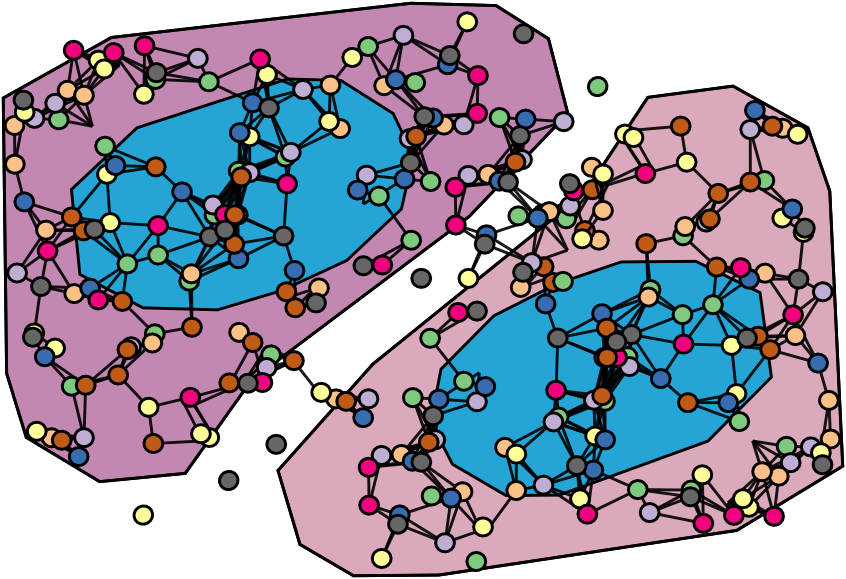
Image-based spatial transcriptomics provide gene expression measurements in tissue slices at single-molecule resolution with spatial context preserved. Modern Graph Neural Network (GNN) models are promising methods for capturing the complex molecular and cellular phenotypes in tissues at single-transcript and single-cell levels. A key application of GNNs is the detection of spatial domains or niches, that is, groups of molecules and/or cells that collaboratively work together to produce complex phenotypes. Due to the vast number of detected transcripts in image-based spatial transcriptomics, applying GNNs on RNA molecule graphs is not trivial.
SpatialRNA is a Python package designed for easy graph and subgraph generations from spatial RNA molecules in tissue samples (Lyu et al,2025).
To get started and become familiar with the types of analyses you can perform using SpatialRNA, we recommend going through the first three tutorials. We also provide a complete set of scripts to help you scale up your analysis to larger sets of samples.
Check out the installation guide.
The detailed step-by-step guide that walks you through the usage of spatialRNA.
Check out our GitHub for the latest development and raising issues.
- Lyu, R., Vannan, A., Kropski, J. A., Banovich, N. E., & McCarthy, D. J. (2025). SpatialRNA: a python package for easy application of Graph Neural Network models on single-molecule spatial transcriptomics dataset. 10.1101/2025.03.20.644258